The Royal Air Force’s recent trials of a laser-guided rocket system, designed to neutralize low-cost drones at a fraction of the cost of traditional missile defenses, mark a pivotal moment in the evolution of asymmetric warfare. Developed by BAE Systems and tested aboard Typhoon jets, this technology promises to democratize air defense, offering nations a means to counter swarms of inexpensive unmanned aerial vehicles with precision-guided munitions. Yet beneath the veneer of innovation lies a paradox: as the UK invests in high-tech solutions to counter low-tech threats, its economic foundations are being eroded by the very conflicts that necessitate such weaponry.
The OECD’s latest forecast, which downgrades the UK’s growth prospects more severely than any other major economy, attributes the slump to energy market volatility and trade disruptions stemming from the US-Israel-Iran war. This conflict, which has drawn in global powers through both direct involvement and proxy posturing, has exposed the UK’s vulnerability to geopolitical shocks. Energy prices, long a volatile factor in economic planning, have spiked anew, while supply chains—already fractured by post-pandemic adjustments—face further strain. The irony is not lost on observers: a nation pouring resources into laser-guided anti-drone systems cannot insulate itself from the fiscal consequences of the same geopolitical maelstrom that makes such systems necessary.
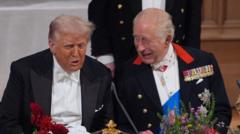
Meanwhile, the Liberal Democrats have seized upon the diplomatic fallout of this conflict to demand the cancellation of King Charles III’s upcoming state visit to the United States. Their rationale hinges on Donald Trump’s public criticism of the UK’s handling of the Iran crisis, which the party claims undermines the visit’s diplomatic utility. This move, framed as a principled stand against perceived disrespect, reveals the performative nature of modern diplomacy. The visit, originally conceived as a gesture of solidarity between allies, has been reduced to a bargaining chip in a game of political theater. The Lib Dems’ position is less about substantive policy than about leveraging symbolic actions to critique the government’s global standing—a meta-debate about image over impact.
The intersection of these narratives produces a surreal landscape where national priorities are negotiated through disjointed levers. The RAF’s drone-killing lasers symbolize technological ingenuity, yet their development coincides with a period of economic contraction that could limit their deployment. The Lib Dems’ push to cancel the royal visit underscores how diplomatic engagements are increasingly treated as conditional transactions rather than enduring commitments. Together, these actions paint a portrait of a nation grappling with the dissonance between projecting power and maintaining prosperity, where the tools of statecraft are wielded with an eye toward both tactical advantage and domestic political gain.
In this context, the UK’s strategic calculus appears to favor theatrical displays of capability over systemic resilience. The laser-guided rocket, the cancelled state visit, and the economic forecasts are not separate issues but symptoms of a broader tendency to address complex challenges through narrow, often contradictory, interventions. As the government touts its investment in cutting-edge defense technology, it does so against a backdrop of stagnating wages and inflationary pressures that threaten social stability. The Lib Dems, meanwhile, advocate for symbolic diplomatic gestures while the nation’s economic ties to conflict zones remain largely unaddressed.
The absurdity reaches its zenith when considering the opportunity costs of these choices. The funding allocated to anti-drone systems could theoretically be redirected toward energy diversification projects to mitigate future price shocks. Conversely, the political energy spent on debating the merits of a royal visit could be channeled into substantive policy reforms to bolster economic resilience. Yet such realignments remain unlikely in a system that rewards visibility over substance. The laser, the cancelled trip, and the downgraded forecast are all performances in a grand play where the audience—both domestic and international—is expected to applaud the spectacle, even as the stage itself threatens to collapse.
Ultimately, the UK’s geopolitical gambits reflect a global trend in which nations increasingly conflate technological capability with strategic success and symbolic diplomacy with effective leadership. In doing so, they risk prioritizing the means over the ends, the spectacle over the substance. As the RAF prepares to deploy its laser-guided rockets and politicians trade barbs over the King’s itinerary, one cannot help but wonder: What happens when the lights dim, the applause fades, and the real work of governance begins?