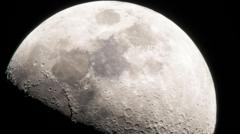
NASA’s latest vision for a permanent Moon base, unveiled with the fanfare of a sci-fi blockbuster, promises to transform lunar dust into a foundation for human civilization. The agency plans to deploy hopping drones and roving vehicles—robotic pioneers that will scout resources, test technologies, and pave the way for Artemis astronauts. These machines, engineered to survive the Moon’s brutal temperature swings and perpetual dust storms, represent decades of incremental innovation. Yet, their purpose is almost quaintly bureaucratic: to create a “sustained presence” that requires, by definition, endless paperwork, funding approvals, and interagency memos. The Moon, it seems, will not be colonized by humans but by acronyms.
Meanwhile, on Earth, researchers at UC Davis have achieved what NASA’s engineers can only dream of: a technological miracle so small it could fit inside a lunar dust particle. Their AI-powered spectrometer chip, no larger than a grain of sand, leverages silicon photonics and machine learning to perform spectral analysis previously confined to lab behemoths. This device could revolutionize medicine, environmental science, and space exploration itself, detecting molecular signatures in Martian soil or human blood with equal ease. Its genius lies in its simplicity—a triumph of shrinking complexity into invisibility. One cannot help but wonder: If we can pack a lab onto a speck of silicon, why do we still require three forms in triplicate to renew a driver’s license?
Across the Atlantic, a different kind of innovation unfolded at Athens International Airport, where a Ryanair flight departed without its passengers, leaving them stranded in a passport control queue that had metastasized into a miles-long labyrinth. Travelers, armed with biometric passports and mobile apps, found themselves defeated by the oldest technology of all: human inefficiency. The incident, dismissed as a “logistical hiccup,” revealed a systemic truth. For all our digital advancements, the line between civilization and chaos is often a single under-staffed desk. The Greek airport’s “mega queue” became a metaphor for modernity itself—a tangle of red tape that no AI spectrometer can unravel.
The connection between these events is not immediately obvious, yet it lies in the friction between scale and systems. NASA’s lunar ambitions require coordinating thousands of contractors, adhering to safety protocols thicker than a lunar lander’s hull, and navigating budget cycles longer than a Mars year. The sand-sized spectrometer, while a marvel, will likely face years of regulatory hurdles before it’s approved for medical use. Even the passport queue, a localized disaster, is part of a global network of bureaucratic inertia where progress is measured in centimeters per hour. Space exploration, cutting-edge tech, and mundane governance are bound by the same universal law: the more ambitious the project, the more it attracts the gravitational pull of bureaucracy.
In the end, the universe may be mocking us. As humans strive to touch the stars, we remain tethered to Earth by the weight of our own systems. The Moon base will require permits. The AI spectrometer will need ethics committees. The passport queue will demand a parliamentary inquiry. Perhaps the true final frontier is not space, but the ability to move through a government building without filling out Form 12-B. Until then, we are all astronauts and bureaucrats, drifting in the vast darkness between moon dust and red tape.