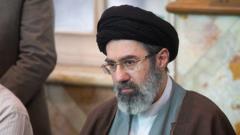
The modern world is governed by specialized discourses, each insular in its jargon and blind to the poetic resonances across domains. Geopolitical transitions and environmental crises are analyzed in separate silos, yet the appointment of Mojtaba Khamenei as Iran’s Supreme Leader and the disintegration of Austria’s glaciers reveal a subterranean dialogue between political rigidity and ecological impermanence. Both narratives, at first glance divorced from each other, converge in their meditation on the fragility of systems under pressure.
Mojtaba Khamenei’s ascension marks a continuation of Iran’s theocratic governance, a fortress of ideological consistency forged by his father. Analysts emphasize his role in reinforcing conservative institutions, suggesting that his leadership will prioritize stability over reform. This resolve to maintain the status quo mirrors the glacial landscape’s historical inertia—both the regime and the ice have endured for decades, seemingly impervious to external forces. Yet, just as glacial ice conceals turbulent flows beneath its surface, Iran’s political permafrost may hide fractures awaiting catalytic stress.
Half a world away, the Austrian Alps are witnessing a silent apocalypse. Glaciers that have sculpted landscapes for millennia are retreating at unprecedented rates, their disappearance a visceral testament to climate change’s relentless march. Scientists warn that these losses threaten not only biodiversity and tourism but also freshwater reserves, rendering the region’s ecological future precarious. Here, the glacier functions as a metaphor for slow violence: a gradual unraveling that contrasts starkly with the abruptness of political succession. Yet both the Iranian polity and the alpine icefields are bounded by the same existential question—how to endure when the environment demands transformation.
The connection lies not in direct causality but in structural analogy. Iran’s political system, like the glacier, operates under the weight of its own mass. The regime’s resistance to Western influence parallels the glacier’s resistance to thermal erosion, both upheld by entrenched structures that delay but cannot prevent change. Meanwhile, the economic pressures driving climate inaction globally—such as fossil fuel dependency—find a geopolitical echo in Iran’s oil-export reliant economy, which sustains its isolationist policies. The Alpine glaciers, dependent on climatic stability, and the Iranian state, dependent on ideological stasis, are both canaries in separate coal mines, singing dissonant yet harmonious warnings.
As Mojtaba Khamenei consolidates power and Austrian skiers lament shrinking slopes, a whimsical hypothesis emerges: perhaps the only way to halt glacial melt is to freeze geopolitical time. Imagine diplomatic summits held in subzero chambers, where negotiations are physically cooled to mirror the cryosphere’s demands. Or envision Iran’s leadership, in a gesture of solidarity with the Alps, deploying its resources to fund artificial snow machines, thereby exchanging petrochemical hegemony for a brief, ironic reprieve from the heat. Such absurdities highlight the futility of addressing interconnected crises through isolated interventions.
Ultimately, the convergence of these narratives suggests that systems—whether political or ecological—respond to stress in binary modes: by calcifying or dissolving. The Iranian regime and the Austrian glaciers are two faces of the same coin, each a testament to the paradox of resilience. In the end, the joke is on the observer who believes they can parse the world without crossing disciplinary boundaries, for the punchline lies in the unexpected adjacency of Tehran’s corridors of power and the crumbling ice of the Alps.