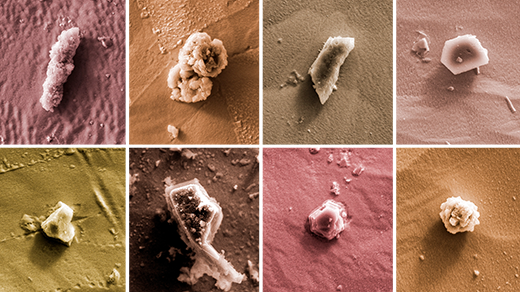
The prevailing cosmological model posits that our solar system coalesced from a primordial dust cloud, its collapse triggered by the shockwave of a nearby supernova. Within this ancient debris, carbonaceous chondrites—rocks rich in presolar grains—preserve isotopic signatures older than the Sun itself. These microscopic fossils, forged in the atmospheres of long-dead stars, challenge our understanding of time and material continuity. Yet their structural complexity, recently imaged at atomic resolution, bears an uncanny resemblance to synthetic nanoscale architectures developed for entirely unrelated purposes.
Half a universe away in both space and application, chemists struggle to design catalysts that can decarbonize industrial processes. The Catalysis App, a nascent tool for organizing reaction data, highlights the field's central paradox: while quantum mechanics governs catalytic efficiency, human intuition remains unable to predict which materials will perform. Traditional catalysts—like platinum-based systems—rely on trial-and-error discovery, a process as random as the cosmic ray spallation that created the isotopes now embedded in Earth's crust.
The hourglass nanographenes developed at the National University of Singapore bridge these realms. Their hourglass-shaped molecular structures exhibit multi-spin entanglement, a quantum phenomenon where electron arrangements remain correlated regardless of distance. This property mirrors the gravitational correlations that linked distant regions of the presolar nebula before its collapse. Just as turbulence in the nebula determined planetary orbits, the precise arrangement of carbon atoms in these nanographenes dictates their magnetic resilience—a critical factor for quantum computing applications.
The connection deepens when considering timescales. Presolar grains endured millennia of interstellar radiation before incorporation into comets, which delivered them to early Earth via impacts. Similarly, catalytic materials must withstand thousands of reaction cycles without degradation. Both systems demand robustness against environmental perturbations—whether cosmic rays or reactive oxygen species. The hourglass structure's resilience, achieved through strategic edge-hydrogenation, echoes the self-protective mineral coatings found on ancient stardust grains.
This analysis suggests a provocative framework: the quantum mechanical principles that stabilized carbon clusters in stellar atmospheres may inform the rational design of earthbound catalysts. If multi-spin entanglement can preserve molecular integrity across astronomical distances, might it also enhance catalytic turnover rates? The notion that lessons from a dying star's final fusion reactions could accelerate green chemistry initiatives underscores the interconnectedness of all material phenomena.
In conclusion, we propose a radical interdisciplinary experiment. By bombarding hourglass nanographenes with isotopically pure gases in a simulated interstellar medium, researchers might uncover whether cosmic heritage influences catalytic performance. If successful, this could vindicate the alchemists' oldest dream—transforming base materials into something transcendent—while forcing a reinterpretation of how stardust-shaped constraints shape technological progress. The universe, it seems, has always been in the business of catalysis; we are merely its latest, self-aware reaction product.