The recent development of an artificial intelligence model capable of deciphering protein-protein interactions with unprecedented accuracy has been hailed as a breakthrough in biomedical research. By mapping the intricate dance of molecular bindings, scientists hope to unlock new pathways for drug discovery and disease understanding. Yet, buried beneath the technical specifications of this innovation lies a curious parallel: the computational frameworks used to analyze biological networks bear a striking resemblance to those employed in geopolitical conflict modeling. This paper examines the unspoken dialogue between these disciplines, revealing how algorithms designed to predict cellular behavior might, in theory, be repurposed to decode the motivations of kidnappers or the trajectory of Middle Eastern strikes.
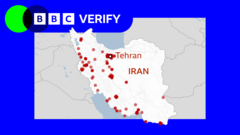
The AI system in question operates by identifying patterns in vast datasets of protein structures, discerning which molecular pairs are likely to bind based on structural complementarity and energetic stability. This process mirrors, albeit unintentionally, the methodologies of intelligence analysts tasked with predicting adversarial actions in conflict zones. In both cases, the goal is to anticipate interactions—whether between amino acid chains or adversarial states—by extrapolating from historical data and environmental constraints. The Middle East, now in its ninth day of escalated hostilities, presents a grim case study: Israel’s strikes in Iran and Lebanon, coupled with Tehran’s retaliatory maneuvers, form a sequence of events that could theoretically be modeled as a series of “binding events” in a geopolitical network. Each attack and counterattack represents a node in a dynamic graph, where edges denote causality and node attributes reflect military capability or political resolve.
Meanwhile, the ongoing investigation into the kidnapping of Nancy Guthrie, mother of television personality Savannah Guthrie, offers another unexpected testing ground for such computational tools. Law enforcement officials claim to have identified the perpetrator’s motive after 41 days of silence, a revelation that hinges on reconstructing the kidnapper’s decision-making process. This mirrors the AI’s task of inferring functional relationships between proteins from sparse experimental data. In both scenarios, the challenge lies in deducing intent from fragmented evidence—a challenge that machine learning algorithms are increasingly equipped to address. If a model can predict which proteins form complexes based on sequence data, could it not also predict which individuals might engage in criminal activity based on behavioral or socioeconomic indicators? The question, while provocative, underscores the versatility (and potential hubris) of modern computational approaches.
The conceptual bridge between these domains becomes clearer when examining the mathematics underpinning both fields. In bioinformatics, interaction networks are often visualized as graphs where proteins are nodes connected by edges representing physical or functional associations. Similarly, geopolitical analysts construct actor-network maps where states, non-state actors, and institutions are nodes linked by alliances, hostilities, or economic ties. The escalation of violence in the Middle East, for instance, can be framed as a cascade of interactions within such a network, where each strike modifies the topology of the graph by strengthening or weakening specific edges. Likewise, the resolution of the Guthrie case may depend on identifying “hub” nodes—key individuals or pieces of evidence—that disproportionately influence the network’s behavior.
This analogy is not without its absurdities. Proteins do not deliberate, and kidnappers are not governed by the laws of thermodynamics. Yet the structural similarities between these systems invite a playful, if cautionary, exploration of cross-disciplinary methodologies. One might imagine a future where conflict resolution teams employ protein-folding algorithms to simulate the “energy landscapes” of diplomatic negotiations, seeking low-energy states of mutual stability. Conversely, biochemists could borrow from military strategy manuals to understand how competitive binding events mimic asymmetric warfare between molecular adversaries.
In conclusion, the convergence of AI-driven biology and geopolitical analysis suggests that the boundaries between disciplines are as porous as the membranes separating cellular compartments. While it remains unlikely that Israeli and Iranian strategists will soon consult structural biologists for advice on deterrence theory, the underlying computational principles remind us that complexity, whether biological or political, often obeys similar rules. Perhaps the next breakthrough in peacekeeping will emerge not from a think tank, but from a deep learning model trained on the interactome of a fruit fly. After all, if an algorithm can predict how two proteins might collide in a crowded cellular environment, why not how two nations might de-escalate in a crowded geopolitical landscape? The answer, much like the elusive kidnapper’s motive or the precise coordinates of a hidden missile site, remains frustratingly out of reach—but the search itself is a testament to human ingenuity’s relentless, if sometimes misguided, ambition.